The story of the discovery of methadone
The discovery of methadone has been the subject of much conjecture and myth. In writing the methadone briefing my co-author Gerald Bennett and I did some digging to get beyond the myths, and find the original records to unearth the true (if not very exciting) story behind the discovery of this important drug.
The origins of the research
In 1939 Otto Eisleb and a colleague O Schaumann, scientists working for the large chemicals conglomerate I G Farbenindustrie at Hoechst-Am-Main, Germany, discovered an effective opioid analgesic drug which they numbered compound 8909 and called Dolantin. This was the discovery of pethidine.
As with diamorphine (heroin) before, and buprenorphine (Temgesic) since, the early hopes of it being 'a new non-addictive analgesic' were not realised.
However the powerful analgesic action of pethidine was much needed during the Second World War. It was being produced commercially by 19393 and at the height of the war in 1944 annual production had risen to 1600 kg (Bäumler 1968).
Meanwhile close colleagues Max Bockmühl and Gustav Ehrhart were working on compounds with a similar structure to Dolantin in the hope of finding:
- Water-soluble hypnotic (sleep-inducing) substances (Erhahart and Ruschig 1972);
- Effective drugs to slow the gastrointestinal tract to make surgery easier (Payte 1991);
- Effective analgesics that were structurally dissimilar to morphine - in the hope that they would be non-addictive and escape the strict controls on opiates (Erhahart and Ruschig 1972).
There is no evidence, as had been widely believed both here and in the USA, that they were working as part of a German attempt, directed by Hitler, to replace opium supplies which had been cut off by the war.
This myth has been widely expanded to attributing one of methadone's first trade names - Dolophine - to being a derivation of Adolf and even that it was called Adolophine in Germany - the 'A' being dropped after the war. In fact the name Dolophine was created for the drug as a trade name after the war by the Eli-Lilly pharmaceutical company in America. It was probably derived from the French dolor (pain) and fin (end) (Payte 1991).
The discovery of 'Hoechst 10820': methadone
During 1937 and the spring and summer of 1938 Bockmühl and Ehrhart worked on the creation of another new substance in the group which they called 'Hoechst 10820' and, later, polamidon.
A patent application was filed on 11 September 1941 and the discovery was formally credited to Bockmühl and Ehrhart – there's a copy of the patent application at the bottom of this page.
It has been asserted that because the new compound's two-dimensional structure had no resemblance to morphine its pain-killing properties were not recognised until after the war had ended (Payte). But although the town of Hoechst was extensively bombed during the war the I G Farbenindustrie factory suffered only slight damage and so limited experimental work was able to continue, stopping only when supplies of coal ran out or when the rail links were broken. In the autumn of 1942, after it had been determined that the drug was both an analgesic and a spasmolytic, it was handed over to the military for further testing under the name Amidon.
There was no attempt to try and get polamidon production levels up to those of pethidine. Construction continued at Hoechst on a new pethidine production plant (Bäumler 1968).
References
Bäumler E (1968) A Century of Chemistry. Econ Verlag, Dusseldorf.
Erhahart G and Ruschig H. (1972) Arzneimittel Entwicklung Wirkung Darstellung, Band 1, Therapeutica mit Wirkung auf das Zentral Nervensystem. Verlag Chemie, Weinheim.
Payte J T. (1991) A brief history of methadone in the treatment of opioid dependence: A personal perspective. Journal of Psychoactive Drugs, 23: 103-7.
The original patent application for the drug now known as methadone
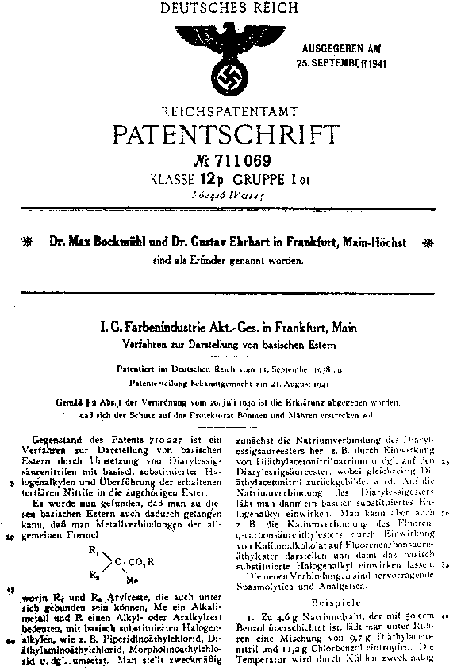
The original methadone patent application